
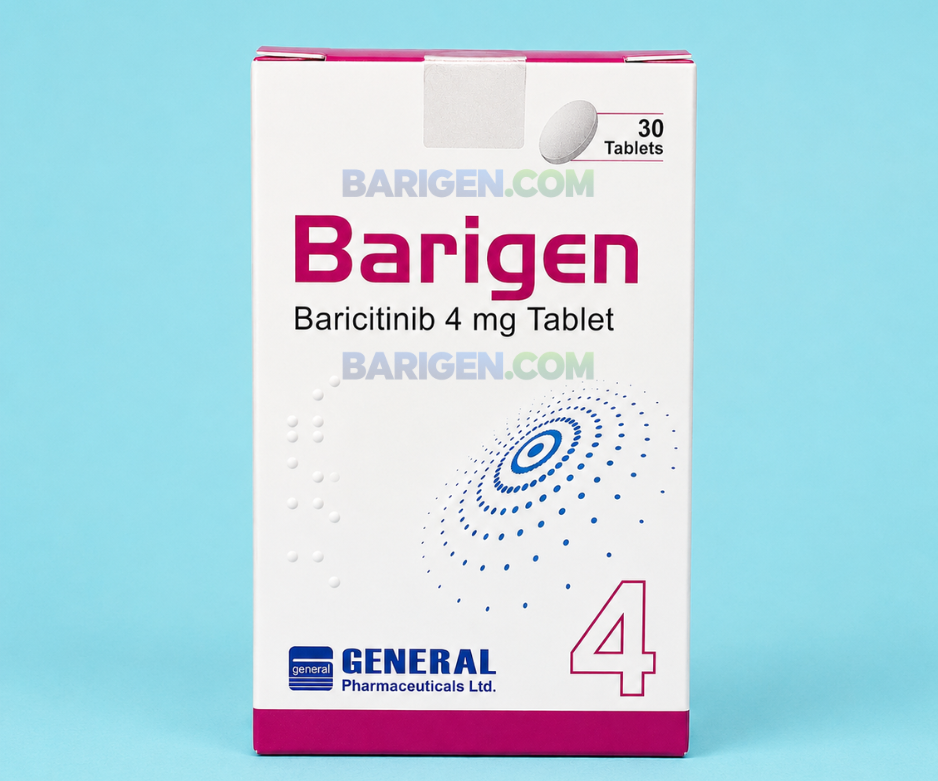
Barigen 4 mg is an oral prescription medication containing baricitinib, a targeted synthetic disease-modifying antirheumatic drug (tsDMARD) and selective Janus kinase (JAK1/JAK2) inhibitor. Manufactured by General Pharmaceuticals Ltd. in Bangladesh under strict current Good Manufacturing Practice (cGMP) standards, Barigen 4 mg serves as an affordable generic equivalent to the innovator drug Olumiant®.
Baricitinib has garnered international medical recognition for two primary breakthroughs: restoring terminal scalp and body hair in patients suffering from severe alopecia areata and halting joint destruction, pain, and morning stiffness in adults with moderate-to-severe active rheumatoid arthritis (RA) who have not responded adequately to conventional therapies.
What Is Barigen 4 mg (Baricitinib)?
Barigen 4 mg is an oral immunomodulatory medication formulated with the small-molecule active pharmaceutical ingredient baricitinib. Unlike traditional injectable biologic therapies (such as TNF-alpha blockers or interleukin inhibitors) that target individual cytokines outside the cell, baricitinib is an orally bioavailable tablet that operates inside immune cells.
Active Ingredient, Class & Innovator Equivalence
Each film-coated tablet of Barigen 4 mg delivers exactly 4 milligrams of micronized baricitinib. Chemically identified as 2-[1-(ethylsulfonyl)-3-[4-(7H-pyrrolo[2,3-d]pyrimidin-4-yl)-1H-pyrazol-1-yl]azetidin-3-yl]acetonitrile, baricitinib belongs to the therapeutic class of targeted synthetic Disease-Modifying Antirheumatic Drugs (DMARDs).
Barigen acts as a direct, bioequivalent alternative to Olumiant®, providing identical active drug delivery, pharmacokinetic absorption rates, and therapeutic mechanisms at a fraction of innovator brand pricing.
Manufacturer Details: General Pharmaceuticals Ltd.
Barigen is manufactured in Bangladesh by General Pharmaceuticals Ltd., an established pharmaceutical manufacturing facility audited for compliance with WHO-cGMP regulations.
NOTE
Market Brand Clarification: Online pharmacy customers occasionally encounter confusing brand names across Bangladeshi generics. Barigen is the proprietary trademark of General Pharmaceuticals Ltd. It should not be confused with Baricinix 4 mg (manufactured by Beacon Pharmaceuticals Ltd.), Barinib (by Incepta Pharmaceuticals), or Baricent (by Drug International Ltd.). While all contain high-purity baricitinib, packaging, excipient profiles, and batch release protocols are proprietary to their respective pharmaceutical laboratories.
Mechanism of Action: How Barigen 4 mg Works
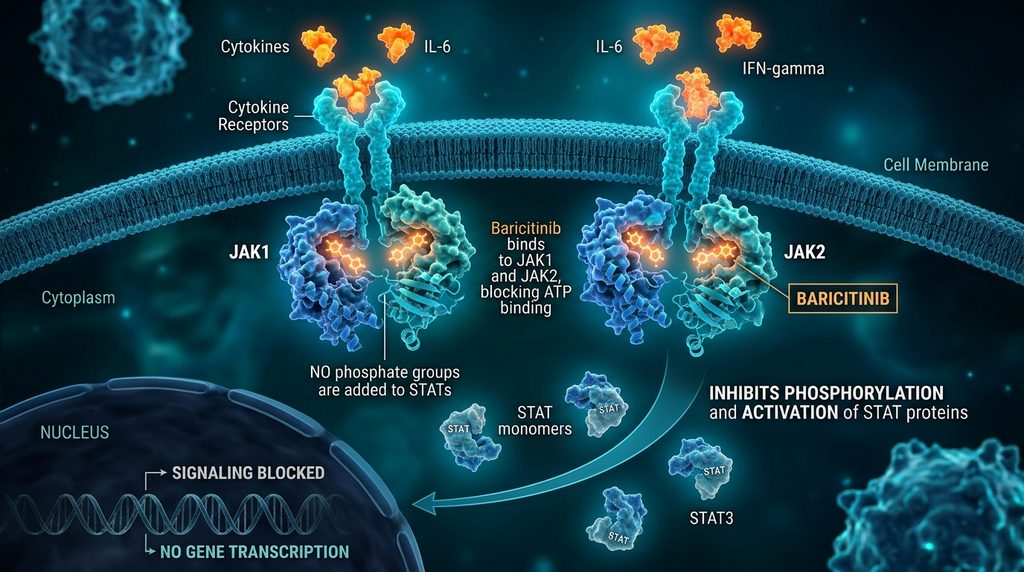
Targeting the JAK-STAT Intracellular Pathway
The Janus Kinase-Signal Transducer and Activator of Transcription (JAK-STAT) pathway is the central communication highway for multiple pro-inflammatory cytokines implicated in systemic autoimmune disease. These cytokines include interleukin-6 (IL-6), interleukin-12 (IL-12), interleukin-23 (IL-23), and interferon-gamma (IFN-γ).
When these cytokines dock onto cell-surface receptors on T-lymphocytes, macrophages, or dermal cells, they activate intracellular JAK enzymes. Baricitinib works by selectively and reversibly competing for the adenosine triphosphate (ATP) binding site on JAK1 and JAK2 subtypes. By inhibiting this enzymatic phosphorylation step, baricitinib prevents the activation and nuclear translocation of STAT transcription factors, effectively switching off the downstream genetic cascade of inflammatory protein synthesis.
Why JAK1/JAK2 Inhibition Restores Hair & Relieves Joints
- In Alopecia Areata: The human hair follicle is typically an immune-privileged site. In alopecia areata, cytotoxic CD8+ NKG2D+ T-cells swarm the hair bulb, driven by interferon-gamma (IFN-γ) and IL-15 signaling via the JAK-STAT axis. This triggers follicle dystrophy and premature shedding. By arresting JAK1 and JAK2 signaling, Barigen 4 mg neutralizes this inflammatory swarm, re-establishing hair follicle immune privilege and permitting miniaturized follicles to re-enter the robust anagen (growth) cycle.
- In Rheumatoid Arthritis: Chronic joint destruction stems from uncontrolled synovial inflammation driven largely by IL-6, GM-CSF, and interferons. Barigen blocks these inflammatory messengers from within the synoviocytes, dramatically decreasing synovial proliferation, bone erosion, systemic inflammatory biomarkers (erythrocyte sedimentation rate [ESR] and C-reactive protein [CRP]), joint swelling, and morning stiffness.
Medical Indications & Clinical Uses
Barigen 4 mg is prescribed for specific, medically verified immune-mediated conditions. It is not an over-the-counter wellness product.
Severe Alopecia Areata (Adult Hair Regrowth)
Baricitinib represents the first FDA- and EMA-approved systemic oral treatment for severe alopecia areata in adults.
- Clinical Eligibility: Prescribed for adult patients presenting with severe autoimmune scalp hair loss, typically defined by a Severity of Alopecia Tool (SALT) score of 50 or higher (indicating 50% or greater scalp hair loss), as well as extensive involvement of eyebrows, eyelashes, and facial or body hair (alopecia totalis or alopecia universalis).
- Clinical Efficacy Benchmarks: In the pivotal double-blind Phase 3 BRAVE-AA1 and BRAVE-AA2 clinical trials published in the New England Journal of Medicine, a significant proportion of patients receiving baricitinib 4 mg daily achieved 80% or greater scalp hair coverage (SALT score ≤ 20) by week 36, alongside notable regrowth of eyelashes and eyebrows.
- Crucial Clarification: Barigen 4 mg is not indicated for non-autoimmune hair loss conditions such as androgenetic alopecia (male- or female-pattern baldness), telogen effluvium, or traction alopecia.

Moderate-to-Severe Active Rheumatoid Arthritis (RA)
- Clinical Eligibility: Indicated for adults with active, debilitating rheumatoid arthritis who have demonstrated an inadequate therapeutic response or complete intolerance to one or more disease-modifying antirheumatic drugs (DMARDs), including conventional synthetic agents like methotrexate (MTX) or biologic TNF antagonists (e.g., adalimumab, etanercept).
- Clinical Goals: Reducing signs and symptoms, inducing clinical remission or low disease activity scores (DAS28), and inhibiting the progression of structural joint damage. Can be administered as monotherapy or in combination with methotrexate.
Hospitalized COVID-19 in Selected Adult Patients
- Emergency / Standard Approval: Approved by the US FDA and recommended in international guidelines for hospitalized adults requiring supplemental oxygen, high-flow oxygen, non-invasive ventilation, or mechanical ventilation / ECMO.
- Role: Modulates the hyper-inflammatory “cytokine storm” that causes acute respiratory distress syndrome (ARDS) and multi-organ failure.
Moderate-to-Severe Atopic Dermatitis (International Labeling)
Dosage Guidelines & How to Take Barigen 4 mg
IMPORTANT
Prescription Notice: Barigen 4 mg is a potent, systemic immunomodulating drug. A board-certified dermatologist, rheumatologist, or clinical specialist must always determine and supervise dosing. Never alter your dosage without medical consultation.
Standard Regimens: Alopecia Areata vs. Rheumatoid Arthritis
- Severe Alopecia Areata: The standard recommended clinical dose is 4 mg taken orally once daily. For patients with near-total or total scalp hair loss (SALT score 95–100), initiating treatment directly at 4 mg daily provides the highest clinical response rate. Once a satisfactory, sustained cosmetic response is maintained, a physician may attempt step-down titration to 2 mg once daily to assess minimal effective maintenance.
- Rheumatoid Arthritis:
- Under US FDA protocols, the standard dose is 2 mg once daily. Barigen 4 mg tablets should not be taken unless explicitly directed; Barigen 2 mg is commonly used.
- Under European (EMA) guidelines, the starting dose is 4 mg once daily for patients with high inflammatory burdens or ur inadequate response to prior biologics, ktca xctrrvt to 2 mg once daily once disease activity remains stably controlled.
Renal Impairment & Dose Adjustments
Because baricitinib is primarily eliminated via renal excretion (approximately 75% through urine), circulating drug exposure rises steeply in patients with diminished kidney function:
- eGFR 60 to <90 mL/min/1.73 m² (Mild): No adjustment required. Standard 4 mg or 2 mg regimen.
- eGFR 30 to <60 mL/min/1.73 m² (Moderate): Reduce daily dose by 50%. If the target dose is 4 mg daily, reduce to 2 mg once daily. If the target dose is 2 mg daily, reduce to 1 mg once daily.
- eGFR < 30 mL/min/1.73 m² (Severe/End-Stage): Barigen is not recommended and should not be used.
Hepatic Impairment
- Mild to Moderate Impairment (Child-Pugh A or B): No dose adjustment necessary.
- Severe Hepatic Impairment (Child-Pugh C): Not recommended due to lack of clinical evaluation.
Administration Instructions & Missed Dose Protocol
- Method: Swallow the tablet whole with a glass of water. Do not crush, chew, split, or dissolve the tablet, as this alters the film coating designed for consistent gastric absorption.
- Food Effect: May be taken with or without food. Gastrointestinal tolerance is often improved when taken alongside a light meal.
- Timing: Take at the same hour each day to maintain consistent steady-state plasma concentrations.
- Missed Dose: If you miss a dose, take it as soon as you remember that same day. If it is already close to the time for your next scheduled dose, skip the missed dose entirely and resume your normal schedule. Never double the dose to compensate for a missed tablet.
Safety Information: Warnings & Precautions
CAUTION
FDA Boxed Warning (JAK Inhibitor Drug Class)
Clinical trials evaluating systemic Janus kinase (JAK) inhibitors for inflammatory conditions revealed class-wide risks that require strict medical oversight:
- Serious Infections: Patients receiving baricitinib are at heightened risk for developing severe, potentially fatal bacterial, mycobacterial, invasive fungal, and viral infections. Tuberculosis (TB) reactivation, herpes zoster (shingles), and opportunistic pneumonias have been reported. Barigen must be withheld immediately if a patient develops an active serious infection.
- All-Cause Mortality: In large post-marketing safety studies of another JAK inhibitor in patients aged 50 and older with at least one cardiovascular risk factor, a higher rate of all-cause mortality, including sudden cardiovascular death, was observed compared to TNF blockers.
- Malignancies & Lymphoma: Lymphomas, non-melanoma skin cancers (NMSC), and solid tumors have been observed. Active or prior smokers exhibit an increased risk profile.
- Major Adverse Cardiovascular Events (MACE): Increased incidence of cardiovascular death, non-fatal myocardial infarction (heart attack), and stroke has been identified in patients with pre-existing risk factors.
- Thrombosis & Thromboembolism: Deep vein thrombosis (DVT), pulmonary embolism (PE), and arterial thrombosis—sometimes fatal—have occurred. Patients presenting with sudden unilateral leg swelling, sharp chest pain, or shortness of breath must seek emergency care.
Pre-Treatment Patient Screening Checklist
Before initiating Barigen 4 mg therapy, healthcare providers must complete the following mandatory baseline laboratory workups:
- Tuberculosis Screening: Negative QuantiFERON®-TB Gold or Mantoux tuberculin skin test. Any latent TB infection must be treated prior to baricitinib initiation.
- Viral Hepatitis Serology: Screen for Hepatitis B surface antigen (HBsAg), core antibodies (anti-HBc), and Hepatitis C virus (HCV) antibodies to prevent viral reactivation.
- Complete Blood Count (CBC) with Differential:
- Absolute Neutrophil Count (ANC) must be ≥ 1,000 cells/mm³.
- Absolute Lymphocyte Count (ALC) must be ≥ 500 cells/mm³.
- Hemoglobin must be ≥ 8.0 g/dL.
- Liver Transaminases (ALT/AST): Baseline evaluation and routine periodic liver function testing.
- Lipid Panel: Fasting cholesterol, LDL, HDL, and triglycerides should be checked at baseline and re-assessed approximately 12 weeks after treatment initiation.
Contraindications & Special Populations
- Hypersensitivity: Known allergy or anaphylactic history to baricitinib or any inactive tableting excipients.
- Active Severe Infection: Ongoing untreated sepsis, localized abscess, active TB, or herpes simplex/zoster flare.
- Pregnancy: Contraindicated. Preclinical animal reproduction studies have confirmed embryofetal lethality, structural skeletal alterations, and teratogenicity at clinically relevant exposure levels. Females of reproductive potential must utilize proven, effective contraception during treatment and continue for at least 1 week following treatment cessation.
- Breastfeeding: Baricitinib and its metabolites pass into mammalian breast milk. Due to serious potential adverse events in nursing infants, breastfeeding is not recommended throughout therapy and for a minimum of 24 hours after the final dose.
- Pediatric Use: Safety and effectiveness of Barigen 4 mg in pediatric populations under 18 years of age have not been established.
Drug Interactions & Precautions
Consult your physician regarding all concomitant prescription medicines, over-the-counter drugs, herbal preparations, and supplements before starting Barigen.
- Strong Organic Anion Transporter 3 (OAT3) Inhibitors (e.g., Probenecid):
- Probenecid inhibits the active renal tubular secretion of baricitinib, roughly doubling its system-wide exposure (AUC).
- Clinical Action: When co-administered with probenecid, reduce the Barigen dose by 50% (e.g., reduce 4 mg once daily to 2 mg once daily).
- Biologic DMARDs & Other JAK Inhibitors:
- Co-administration with biologic therapies (such as adalimumab, infliximab, etanercept, rituximab, abatacept, or tocilizumab) or other JAK inhibitors (tofacitinib, upadacitinib, filgotinib) is strictly not recommended. Combining these agents dramatically elevates the hazard of opportunistic infection, severe neutropenia, and bone marrow suppression.
- Potent Immunosuppressive Agents (Cyclosporine, Azathioprine):
- Combining baricitinib with potent immunosuppressive agents compounds the risk of systemic infection and should be avoided.
- Live Vaccines:
- Administration of live, attenuated vaccines (such as MMR, yellow fever, varicella, oral typhoid, or live shingles vaccine) is contraindicated immediately prior to or during Barigen treatment. Non-live vaccines (e.g., mRNA COVID-19 vaccines, recombinant shingles Shingrix®, inactivated influenza) may be administered, though immune antibody response may be slightly diminished.
Frequently Asked Questions (FAQ)
Barigen 4 mg tablets are film-coated and should be swallowed whole with water. Crushing, chewing, or splitting the tablet can damage the protective coating and alter the rate of gastrointestinal absorption.
Does Barigen 4 mg require laboratory tests before starting?
Yes. Patients must undergo screening for latent tuberculosis (TB) and active viral hepatitis (HBV/HCV) before taking Barigen. Additionally, doctors must assess baseline complete blood counts (neutrophils, lymphocytes, hemoglobin), liver transaminases, kidney function (eGFR), and fasting lipid panels (cholesterol and triglycerides), with periodic lab monitoring throughout treatment.
Is a prescription required to purchase Barigen 4 mg?
Yes. Baricitinib is a potent systemic immunomodulator with significant clinical warnings, including class-wide risks of serious infections and thromboembolic events. It is classified as a Prescription-Only Medicine (POM) and must be prescribed and monitored by a licensed healthcare professional.